Beyond the Ballot
2026 Midterm Elections & Municipal Credit
Results as of 12pm EST on 11/4/26
Initial results from the 2026 Midterm elections indicate that Democrats will control Congress by significant margins and take more power in state legislatures. The results have mixed investment implications for municipal bond investors. Key ballot initiatives in California, Colorado, Florida, and Washington are also likely to influence municipal credit quality and valuations.
Federal Races
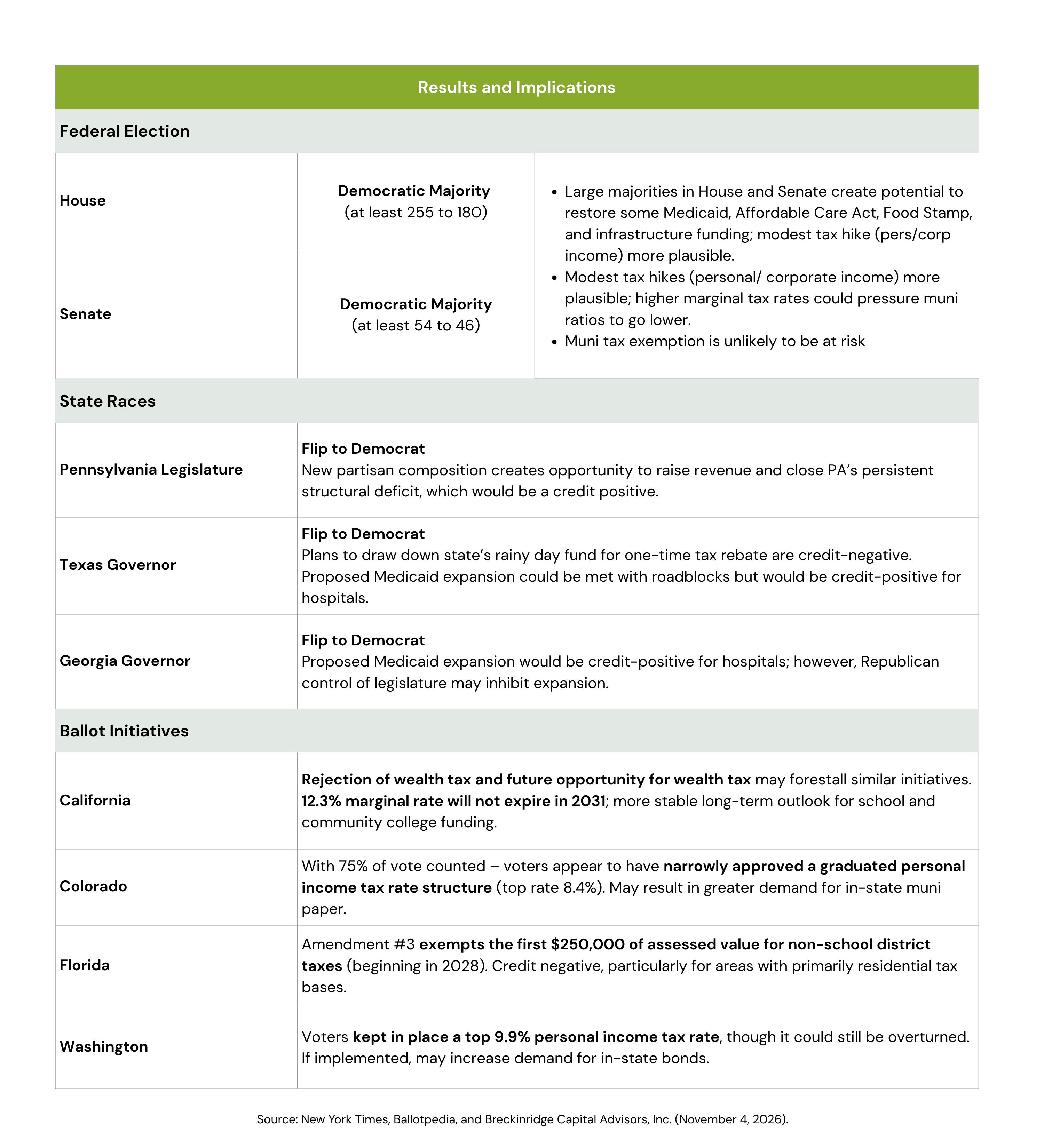
As of Wednesday morning, November 4th, 2026, Democrats were projected to control the House of Representatives by at least a 255 to 180 margin and the Senate by at least a 54 to 46 margin. Both would be the largest margins for any party since the post-GFC election in November 2008.1
The unexpectedly large margins are modestly credit-positive for municipal issuers. Congress is now more likely to restore some Affordable Care Act subsidies and Medicaid funding that was curtailed in the 2025 “One Big Beautiful Bill Act.” This would benefit hospitals and states.2 The pending surface transportation bill is now also likely to be reauthorized with more funding.3 Cuts to university research grants are likely to slow.
The large margins modestly increase the likelihood that federal tax rates increase. As we noted in our 2026 mid-year Outlook, President Trump has previously supported higher taxes on the wealthy; and last year, 18 Republican senators supported higher marginal income tax rates to fund rural hospitals.4 Higher marginal rates could pressure muni ratios lower. Risks to the municipal bond tax exemption, itself, remain low, in our view.
Congress is also more likely to address tariffs through legislation, consider slowing down data center development, and negotiate for changes to immigration policy, among other priorities. Each effort would have manageable and modest regional economic impact, for most issuers.
Lastly, “fiscal dominance” has waned as a market concern in recent months. But to the degree investors remain worried about the Fed’s independence, split control between executive and legislative branches of government is likely a positive development.
State Races
Democrats gained five “trifectas” at the state level, meaning the party now controls the governorship, state house, and state senate in five additional states (MI, MN, NV, PA, and WI). Democrats also ended supermajorities in the Florida legislature and “flipped” partisan control in legislative chambers in North Carolina and New Hampshire.
Pennsylvania: In our view, the most relevant state legislative change is in Pennsylvania where Democrats’ “trifecta” is the first since 1993. The state has ample revenue capacity and low debt, but it has passed structurally imbalanced budgets for several consecutive years, weighing on the state’s bond rating (currently Aa2/A+). The new partisan composition creates potential for enacting a sustainable long-term revenue source to keep operations balanced.
Georgia: The incoming Democratic governor has proposed expanding Medicaid, which is typically credit-positive for hospitals in states that adopt it. However, the legislature remains under Republican control, leaving the proposal’s prospects uncertain.
Texas: Similar to Georgia, Texas could expand Medicaid, a credit-positive for hospitals. Republican legislative control may present roadblocks to passing. Additionally, the incoming Texas governor has also proposed drawing down $17 billion (62%) of the state’s rainy day fund balance to fund a one-time tax rebate to families.5 The governor has also proposed increases for public school funding. Neither proposal is likely to impact the state’s AAA bond rating, but the proposals highlight a change in fiscal priorities and invite scrutiny over how the state might be run, for the medium-term.
Ballot Initiatives
Investment-relevant ballot initiatives were decided in several states.
- California. Voters rejected a 5% wealth tax on billionaires, and instead supported a countervailing proposal that effectively bans future wealth taxes.6 The margins were not close, which likely tempers momentum for similar initiatives, elsewhere. Rejection of the tax is likely a credit-positive for California. As we noted in an April 2026 commentary, the tax would be difficult to administer, invite sustained litigation, and would likely result in outmigration of some high-income residents.7
California voters also chose to make permanent the state’s current 12.3% income tax rate. The rate was set to expire in 2031, leaving a revenue shortfall for funds earmarked for K-12 public schools and community colleges. Extension of the tax is, on balance, a positive for fiscal stability.
Lastly, voters in the San Francisco area approved two sales tax measures dedicated to mass transit. The new taxes should stabilize operations and bond ratings for several regional issuers, over the near-term.8 - Colorado. With 75% of the vote in, Colorado voters appear to have narrowly approved a measure to create a graduated personal income tax rate structure and impose a top rate of 8.4%, up from the current 4.4%.9 The new rate should increase demand for Colorado bonds from in-state residents.
- Florida. Voters passed Amendment #3, which, among other things, exempts from assessment the first $250,000 of assessed value for non-school district taxes (beginning in 2028). The proposal could result in negative rating actions for some local government issuers, especially those with small, predominantly residential tax bases, and mid-tier priced homes.
- Washington. Voters chose to keep in place a recent law that imposes a top 9.9% personal income tax rate. This tax remains legally questionable, per the state constitution, but is scheduled to take effect in January 2028.10 If sanctioned by the State Supreme Court over the next few months, the new rate should increase demand for in-state bonds from Washington residents, as in Colorado.
[1] Party Divisions of the House of Representatives, 1789 to Present. https://history.house.gov/Institution/Party-Divisions/Party-Divisions/.
[2] KFF. “Implementation Dates for 2025 Budget Reconciliation Law.” https://www.kff.org/medicaid/implementation-dates-for-2025-budget-reconciliation-law/
[3] Association of Equipment Manufacturers. “Surface Transportation Reauthorization Enters a Critical Stretch.” https://www.aem.org/news/surface-transportation-reauthorization-enters-a-critical-stretch
[4] Breckinridge Capital Advisors, “Mid-Year Municipal Market Outlook.” https://www.breckinridge.com/insights/mid-year-municipal-market-outlook-2026
[5] Gina Hinojosa for Texas Governor. https://ginafortexas.com/priority/an-affordable-texas-that-works-for-everyone/
[6] CA Prop. 42.
[7] Breckinridge Capital Advisors. “Wealth Taxes, Public Benefit Fraud, and What Matters for Muni Bonds.” https://www.breckinridge.com/insights/wealth-taxes-public-benefit-fraud-and-what-matters-for-muni-bonds
[8] Leahy, Garrett. “Train crash averted: Voters approve Regional Transit Measure, Prop. H.” https://sfstandard.com/2026/11/03/bay-area-transit-tax-bart-caltrain/
[9] Colorado Amendment #87
[10] Washington Initiative #645.
DISCLAIMERS:
The content is intended for investment professionals and institutional investors.
This material provides general information and should not be construed as a solicitation or offer of services or products or as legal, tax or investment advice. Nothing contained herein should be considered a guide to security selection, asset allocation or portfolio construction.
All information and opinions are current as of the dates indicated and are subject to change. Breckinridge believes the data provided by unaffiliated third parties to be reliable but investors should conduct their own independent verification prior to use. Some economic and market conditions contained herein have been obtained from published sources and/or prepared by third parties, and in certain cases have not been updated through the date hereof.
There is no assurance that any estimate, target, projection or forward-looking statement (collectively, “estimates”) included in this material will be accurate or prove to be profitable; actual results may differ substantially. Breckinridge estimates are based on Breckinridge’s research, analysis and assumptions. Other events that were not considered in formulating such projections could occur and may significantly affect the outcome, returns or performance.
All investments involve risk, including loss of principal. No investment or risk management strategy, including diversification, can guarantee positive results or risk elimination in any market. Periods of elevated market volatility can significantly impact the value of securities. Investors should consult with their advisors to understand how these risks may affect their portfolios and to develop a strategy that aligns with their financial goals and risk tolerances.
Active investing generally involves more risks than laddered strategies because active managers may take on greater market risk to outperform their index. There is no guarantee that either passive or active investing will achieve their objectives. Active strategies also tend to have higher management fees and operating costs than passive strategies. Investors should consider all the differences and risks before making any investment decisions. Active management does not guarantee a profit or protect against a loss.
Past performance is not indicative of future results. Breckinridge makes no assurances, warranties or representations that any strategies described herein will meet their investment objectives or incur any profits. Performance results for Breckinridge’s investment strategies include the reinvestment of interest and any other earnings, but do not reflect any brokerage or trading costs a client would have paid. Results may not reflect the impact that any material market or economic factors would have had on the accounts during the time period. Due to differences in client restrictions, objectives, cash flows, and other such factors, individual client account performance may differ substantially from the performance presented.
Fixed income investments have varying degrees of credit risk, interest rate risk, default risk, and prepayment and extension risk. In general, bond prices rise when interest rates fall and vice versa.
Equity investments are volatile and can decline significantly in response to investor reception of the issuer, market, economic, industry, political, regulatory or other conditions.
Breckinridge believes the data provided by unaffiliated third parties, including rating agencies, to be reliable but investors should conduct their own independent verification prior to use. Some economic and market conditions contained herein have been obtained from published sources and/or prepared by third parties, and in certain cases have not been updated through the date hereof. All information contained herein is subject to revision. Any third-party websites included in the content has been provided for reference only, and does not necessarily indicate an endorsement.