

Investment Review and Outlook
IG Credit Had a Tough First Quarter but Outperformed Equities
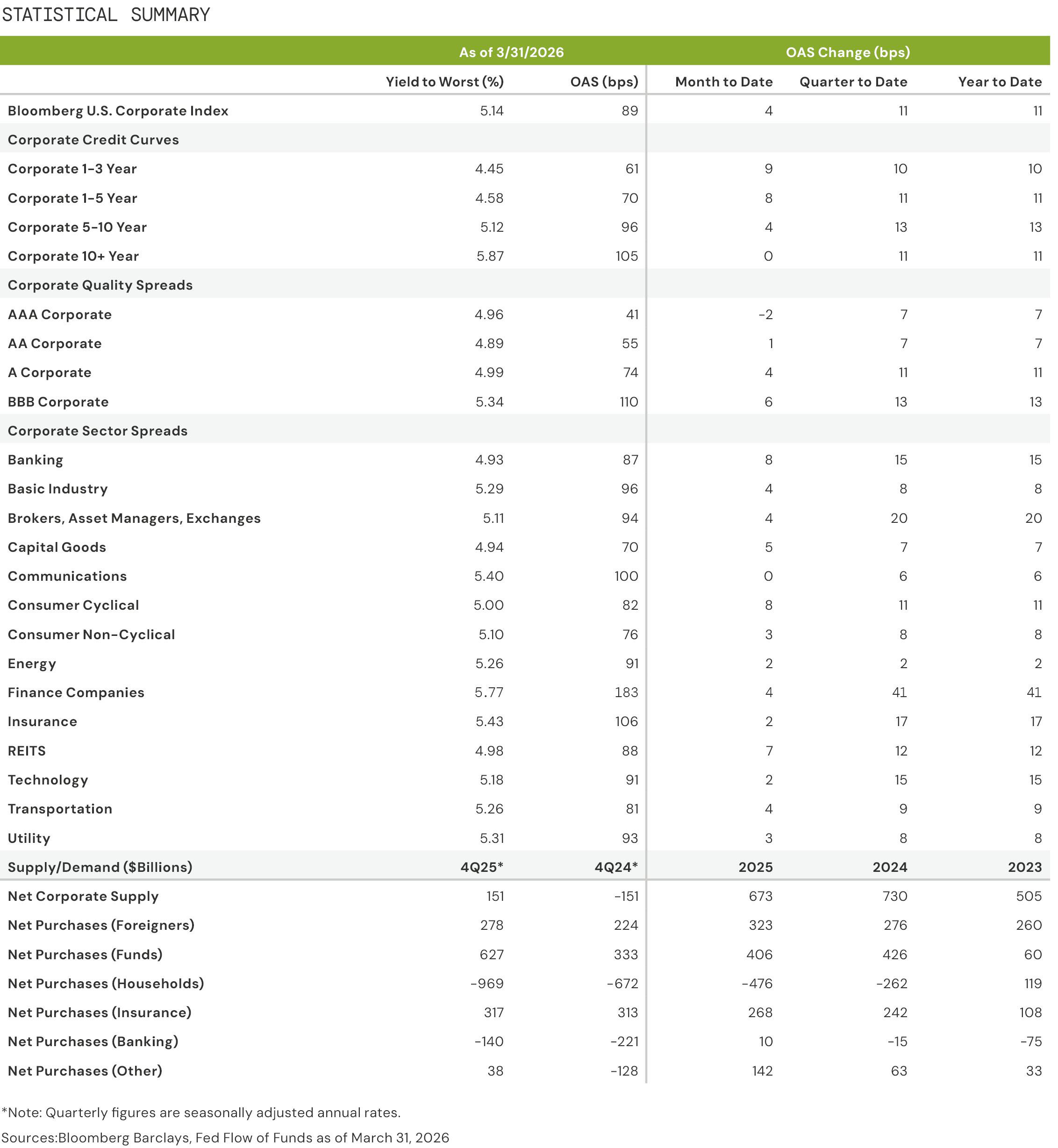
After hitting their tightest level in 20 years in January, corporate spreads widened by 11bps in 1Q26, finishing at an option-adjusted spread (OAS) of +89bps.5 Valuations matter and spreads were in the 2nd percentile in January over a 20-year lookback. Forecasting a modest widening bias this year was not a tough call in our view. We believe current spreads in the 13th percentile are not compelling overall, but volatility and sector divergence have created select opportunities. Quality spreads widened with the A Index and BBB Index 11bps and 13bps wider, respectively. The A/BBB spread differential of 39bps is still tight relative to recent history with a Z-Score6 of negative 1.5 compared to the five year average.7
We see potential tactical opportunities in short- to intermediate-term corporate bonds on wider spreads and more favorable breakevens.8 We expected to see more 30-year bond issuance, which emerged in the first quarter, modestly steepening credit curves. With underperformance in the first quarter, we think more favorable relative value has emerged in the capital structures of highly-rated financial institutions. Above-average yields, solid investor demand, and stable credit fundamentals are counterbalanced by tight spreads, high issuance, private credit and sub-prime stresses, and acute geopolitical risks, driving our modest overweight to the corporate sector with a defensive posture.
The Breckinridge Investment Committee’s macro-outlook is for moderate real economic growth in 2026. While job creation is low, growth is being driven by fiscal stimulus, consumer spending, and capex. We do not expect the Fed to cut rates this year. The Federal Reserve’s easing bias seems to be on hold with the Middle East conflict driving oil prices materially higher, impacting near-term inflation expectations. Our expectations are for the 10-year Treasury to remain range bound in the 4 percent to 4.5 percent context. We view the income proposition for IG credit as attractive with the Index yield over 5-percent at the end of 1Q26.9
Valuations: Sector Dispersion and Opportunities

Corporate spreads were 11bps wider in 1Q26 closing at an OAS of +89bps.10 Valuations argue for a defensive stance, while an IG yield over 5-percent, in the 72nd percentile, may support investor demand.11 With a back-up in interest rates and spreads, both total and excess returns were negative in 1Q26. The yield-to-worst (YTW)12 for the Index moved 33bps higher in the first quarter and was 5.16 percent on March 31.13
Higher quality AAA/AA corporates (+7bps) outperformed A-rated (+11bps) and BBB-rated (+13bps) corporates in 1Q26. Along the curve, short corporates (+10bps) slightly outperformed corporate maturities in the intermediate (+11bps) and long (+11bps) ranges. Financial Institutions (+17bps) meaningfully underperformed Industrials (+9bps) and Utilities (+8bps) in the first quarter, with private credit and sub-prime stresses weighing on investor sentiment. Technology (+15bps) underperformed, as sharply rising AI related capex drove record new issue supply, weighing on certain sector constituents. Energy (+2bps) was the best performing sector, with oil and gas prices moving sharply higher during 1Q26.14
Technicals: Record Supply and Still Solid Demand

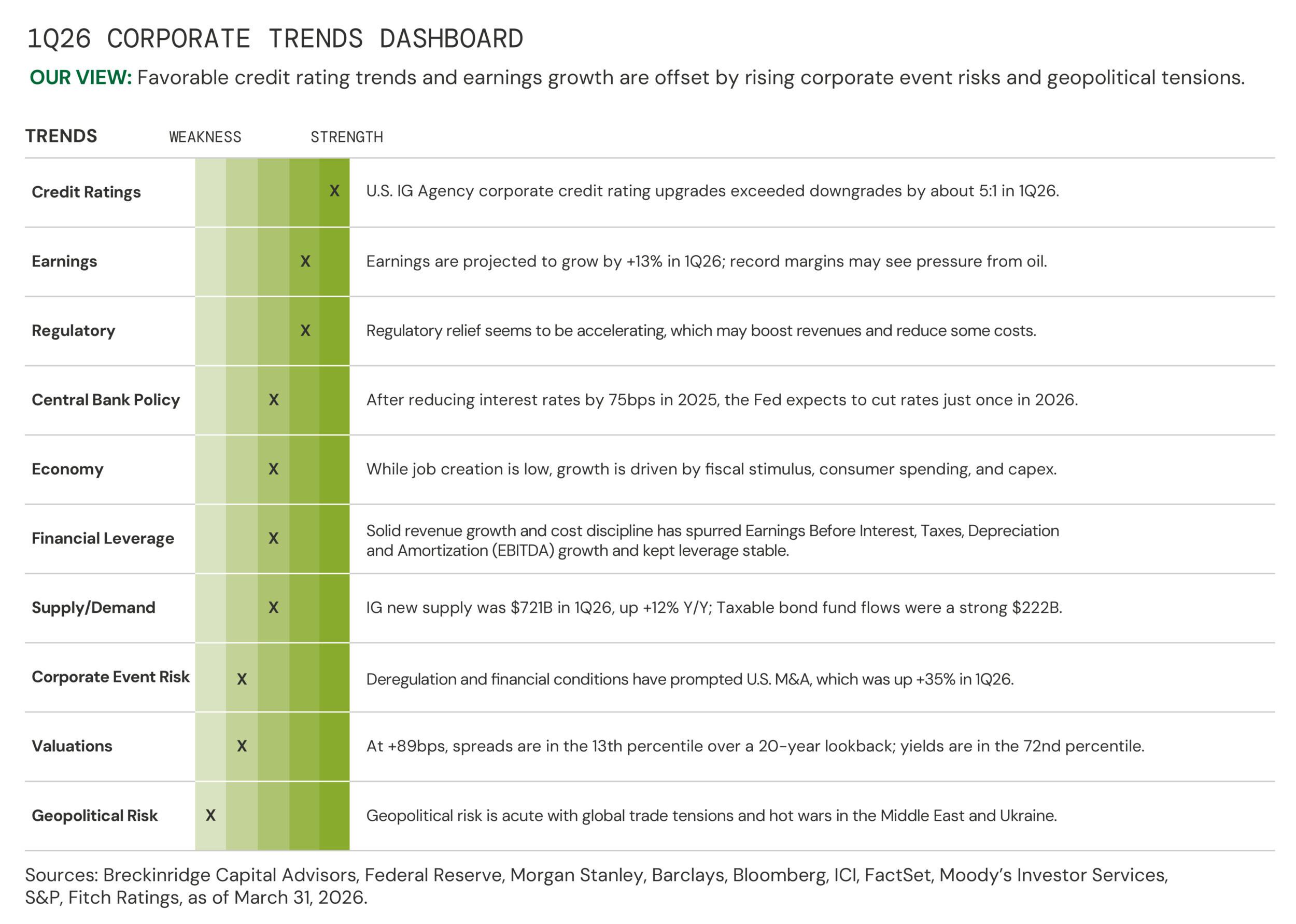
Record IG bond issuance was driven by high refinancing needs, rising capex related to AI investments, and debt-funded M&A activity in 1Q26. Gross IG supply was $721 billion in 1Q26, up 12-percent y/y.15 Net issuance, after $408 billion of redemptions, was $313 billion. Taxable bond fund flows were $222 billion in 1Q26, per ICI, up $114 billion y/y. Net foreign buying of corporate bonds was stable through the end of January.16
Spread volatility driven by geopolitics, AI, and private credit concerns did have a market impact with some “no deal” days and periods when new issues traded wider. As expected, hyperscalers brought large, multi-tranche bond deals that were priced to move given the large size of the borrowings. The Technology sector was the third largest borrower, issuing $64 billion and adjacent sector Communications issued $50 billion. Tasked with increasing electric grid capacity to power data centers among other uses, Utilities issued $56 billion in the first quarter. The Financials sector maintained its dominance, issuing $274 billion of bonds in the first quarter based on high redemptions, regulatory capital requirements, and balance sheet growth.17
Fundamentals: Steady Leverage and Record Margins

We see stable credit fundamentals for Industrials.18 Credit is supported by solid revenue growth and cost discipline, which are driving margin improvement and steady debt metrics. Earnings are projected to grow by 13 percent in 1Q26; record margins may see pressure from oil.19
Industrials margins continued their steady march higher and we think corporate investments in AI may drive additional costs savings and productivity.20 Forecasts for solid growth in operating earnings suggest a constructive backdrop in credit.21 However, capex and M&A are rising and may strain metrics if heavily debt funded. Deregulation and financial conditions have prompted U.S. M&A, which was up 35 percent in 1Q26.22
U.S. IG Agency corporate credit rating upgrades exceeded downgrades by about 5:1 in 1Q26.23 Regulatory relief is accelerating, which may boost revenues and reduce costs. Sharply rising capex is a risk to AI exposed sectors such as Tech and Utilities, although strong balance sheets and regulated business models mitigate added leverage, respectively. Bank credit looks stable in our view, although capital has peaked, private credit and sub-prime consumer stresses are risks. Growth in bank loans to non-depository financial institutions (NDFIs) has been swift and bears close monitoring.24
[1] The BBG U.S. IG Corporate Bond Index is an unmanaged market-value-weighted index of IG corporate fixed-rate debt issues with maturities of one year or more. You cannot invest directly in an index.
[2] The BBG U.S. IG Corporate Bond Index, Option-Adjusted Spread (OAS) vs Treasury Curve, Breckinridge, 3/31/26.
[3] Barclays FICC Research, Credit Strategy, US Investment Grade Corporate Update, March 2026, 4/1/26.
[4] Barclays FICC Research, U.S. Investment Grade Credit Metrics – Q4 25 Update: Stable Metrics, 3/16/26.
[5] The BBG U.S. IG Corporate Bond Index, Option-Adjusted Spread (OAS) vs Treasury Curve, Breckinridge, 3/31/26.
[6] A Z-Score measures how many standard deviations a specific data point is above or below the mean. It converts raw data into a standardized scale, allowing for comparison between different datasets.
[7] Bloomberg U.S. IG Corporate Bond Index, Breckinridge, March 31, 2026.
[8] Bloomberg, Will I Lose Money? Credit Buyers Turn to Break evens for Clues, Ronan Martin, October 1, 2025. Breakeven credit spread widening refers to calculating the amount a bond’s spread can increase before the bond’s total return becomes negative. For example, a bond earnings 100 bps (1%) but with a 2-year spread duration can withstand a 50 bps (0.5%) widening before breaking even on its spread return.
[9] Bloomberg U.S. IG Corporate Bond Index, Breckinridge, March 31, 2026.
[10] The BBG U.S. IG Corporate Bond Index, Option-Adjusted Spread (OAS) vs Treasury Curve, Breckinridge, 3/31/26.
[11] Ibid.
[12] Yield to worst is a financial metric that helps investors assess the minimum yield they can expect from a bond under various scenarios.
[13] Bloomberg U.S. IG Corporate Bond Index, Breckinridge, March 31, 2026.
[14] Ibid.
[15] Investment Company Institute (ICI), Combined Estimated Taxable Bond Long-Term Flows and ETFs, 4/1/26.
[16] Treasury Capital International (TIC), TIC Data for January 2026, Net Corporate Bond Cross-Border Flows, 3/18/26.
[17] Bloomberg, U.S. Investment Grade Corporate Bond Volume by Sector, 3/31/26.
[18] Barclays FICC Research, U.S. Investment Grade Credit Metrics – Q1 26 Update: Stable Metrics, 3/16/26.
[19] Earnings are projected to grow 13 percent in 1Q26, Earnings Insight, FactSet, April 2, 2026.
[20] Barclays FICC Research, U.S. Investment Grade Credit Metrics – Q1 26 Update: Stable Metrics, 3/16/26.
[21] Earnings are projected to grow 13 percent in 1Q26, Earnings Insight, FactSet, April 2, 2026.
[22] Bloomberg, Merger, and acquisitions were up 35 percent in 1Q26, 3/31/26.
[23] Bloomberg, U.S. IG Agency rating upgrades exceeded downgrades by 5:1 in 1Q26, 3/31/26.
[24] Loans to NDFIs is 16% of loans up from 7% five years ago, Federal Reserve H.8 report, Barclays, 3/18/26.
BCAI-BCAI-04062026-arkbvrba (4/8/2026)
DISCLAIMER:
The content is intended for investment professionals and institutional investors.
This material provides general information and should not be construed as a solicitation or offer of services or products or as legal, tax or investment advice. Nothing contained herein should be considered a guide to security selection, asset allocation, or portfolio construction.
All information and opinions are current as of the dates indicated and are subject to change. Breckinridge believes the data provided by unaffiliated third parties to be dependable, but investors should conduct their own independent verification prior to use. Some economic and market conditions contained herein have been obtained from published sources and/or prepared by third parties, and in certain cases have not been updated through the date hereof.
There is no assurance that any estimate, target, projection, or forward-looking statement (collectively, “estimates”) included in this material will be accurate or prove to be profitable; actual results may differ substantially. Breckinridge estimates are based on Breckinridge’s research, analysis, and assumptions. Other events that were not considered in formulating such projections could occur and may significantly affect the outcome, returns or performance.
Not all securities or issuers mentioned represent holdings in client portfolios. Some securities have been provided for illustrative purposes only and should not be construed as investment recommendations. Any illustrative engagement or sustainability analysis examples are intended to demonstrate Breckinridge’s research and investment process.
Yields and other characteristics are metrics that can help investors in valuing a security, portfolio, or composite. Yields do not represent performance results, but they are one of several components that contribute to the return of a security, portfolio, or composite. Yields and other characteristics are presented gross of advisory fees.
All investments involve risk, including loss of principal. No investment or risk management strategy, including diversification, can guarantee positive results or risk elimination in any market. Periods of elevated market volatility can significantly impact the value of securities. Investors should consult with their advisors to understand how these risks may affect their portfolios and to develop a strategy that aligns with their financial goals and risk tolerances.
Past performance is not indicative of future results. Breckinridge makes no assurances, warranties, or representations that any strategies described herein will meet their investment objectives or incur any profits. Performance results for Breckinridge’s investment strategies include the reinvestment of interest and any other earnings, but do not reflect any brokerage or trading costs a client would have paid. Results may not reflect the impact that any material market or economic factors would have had on the accounts during the time period. Due to differences in client restrictions, objectives, cash flows, and other such factors, individual client account performance may differ substantially from the performance presented.
Actual client advisory fees may differ from the advisory fee used to calculate net performance results. Client returns will be reduced by the advisory fees and any other expenses incurred in the management of their accounts. For example, an advisory fee of 1 percent compounded over a 10-year period would reduce a 10 percent return to a 9 percent annual return. Additional information on fees can be found in Breckinridge’s Form ADV Part 2A.
Index results are shown for illustrative purposes and do not represent the performance of any specific investment. Indices are unmanaged and investors cannot directly invest in them. They do not reflect any management, custody, transaction, or other expenses, and generally assume reinvestment of dividends, income, and capital gains. Performance of indices may be more or less volatile than any investment strategy.
Fixed income investments have varying degrees of credit risk, interest rate risk, default risk, and prepayment and extension risk. In general, bond prices rise when interest rates fall and vice versa.
Equity investments are volatile and can decline significantly in response to investor reception of the issuer, market, economic, industry, political, regulatory, or other conditions.
Breckinridge believes the data provided by unaffiliated third parties, including rating agencies, to be reliable but investors should conduct their own independent verification prior to use. Some economic and market conditions contained herein have been obtained from published sources and/or prepared by third parties, and in certain cases have not been updated through the date hereof. All information contained herein is subject to revision. Any third-party websites included in the content has been provided for reference only, and does not necessarily indicate an endorsement.
Certain third parties require us to include the following language when using their information:
BLOOMBERG® is a trademark and service mark of Bloomberg Finance L.P. and its affiliates (collectively “Bloomberg”). Bloomberg does not approve or endorse this material or guarantees the accuracy or completeness of any information herein, or makes any warranty, express or implied, as to the results to be obtained therefrom and, to the maximum extent allowed by law, neither shall have any liability or responsibility for injury or damages arising in connection therewith.
The S&P500 Index (“Index”) and associated data is a product of S&P Dow Jones Indices LLC, its affiliates and/or their licensors and has been licensed for use by Breckinridge. © 2025 S&P Dow Jones Indices LLC, its affiliates, and/or their licensors. All rights reserved. Redistribution or reproduction in whole or in part are prohibited without written permission of S&P Dow Jones Indices LLC. For more information on any of S&P Dow Jones Indices LLC’s indices please visit www.spdji.com. S&P® is a registered trademark of Standard & Poor’s Financial Services LLC (“SPFS”) and Dow Jones® is a registered trademark of Dow Jones Trademark Holdings LLC (“Dow Jones”). Neither S&P Dow Jones Indices LLC, SPFS, Dow Jones, their affiliates nor their licensors (“S&P DJI”) make any representation or warranty, express or implied, as to the ability of any index to accurately represent the asset class or market sector that it purports to represent and S&P DJI shall have no liability for any errors, omissions, or interruptions of any index or the data included therein.


Subscribe to Insights
Sign up to receive curated insights directly in your inbox.


